Arpa Llanera
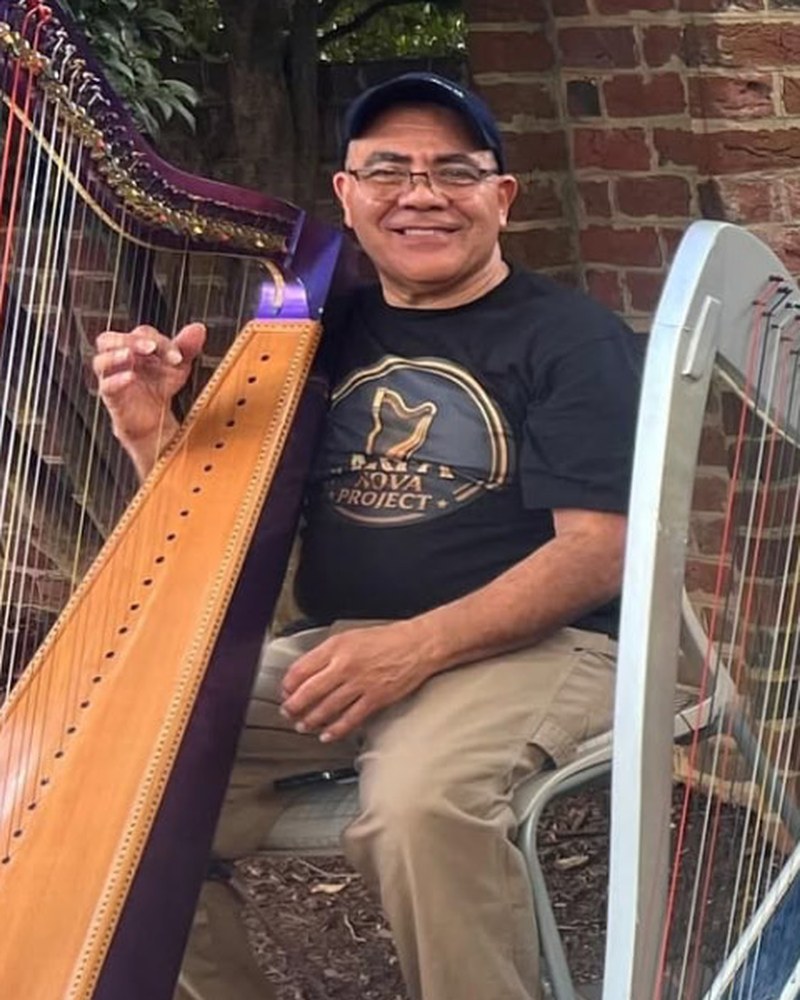
José Rafael Alcalá
José Rafael Alcalá, a life dedicated to Venezuelan music José Rafael Alcalá Figuera developed a deep connection with Venezuelan music from a very young age. During his childhood, his interest in the musical world led him, at ten years old, to audition before the renowned maestro Vicente Emilio Sojo, an early experience that shaped his first steps in artistic training.
Around the age of thirteen, the harp began to occupy a central place in his life, becoming the primary instrument to express his identity and delve into the traditional Venezuelan repertoire, a passion that over time would lead him to share stages with prominent performers and ensembles.
Around 1970, at approximately fifteen years of age, he participated in the iconic radio program Rumbos, Coplas y Canciones, broadcast by Radio Rumbos under the direction of the great maestro Simón Díaz and the production of Virgilio Galindo. That experience allowed him to actively integrate into the country's artistic and radio scene, firmly strengthening his calling. During high school, he directed the musical and vocal ensemble Contrapolo Herreriano, composed of a dozen young people. Under his direction, the group performed at various high schools in Caracas and on radio stations, enhancing his skills as a musician and director. A memorable milestone of this period was having maestro Juan Vicente Torrealba, a pinnacle figure of Venezuelan folklore, as the godfather of his graduating class, a bond of deep personal pride that connected his formative years with one of the great references of national music. Later, he continued his university education in Barquisimeto without pausing his musical work. Throughout his professional development, he participated in multiple projects, accompaniments, and performances that significantly expanded his strength as a harpist.
His career led him to collaborate and share stages with illustrious figures of Venezuelan music, among whom stand out Alfredo Sadel (“El Tenor Favorito de América”), Maira Martí (“La voz de oro de Venezuela”), Magdalena Sánchez, Nora Suárez, Luis D’Ubaldo, Antonio Heredia, Salvador González, José “Catire” Carpio, Cheo Hernández Prisco, Gerardo Brito, Juan del Campo, and Bertica Medina. Likewise, he was part of projects linked to Fantasía Criolla and Los Venezolanos Primero on Radio Lara.
His international projection included performances and artistic activities in Puerto Rico, Chile—particularly in Santiago—and the United States, experiences that enriched his perspective and strengthened the dissemination of traditional Venezuelan music abroad.
In recent years, he has kept his dedication to the harp alive through initiatives such as Arpa Nova Project, reaffirming his commitment to bringing the sound of the harp to new generations and stages.